
Written by Christian Jerusalem
A former client of mine — I’ll call him Rainer, because that’s not his name — sat across from me in March with a look I’ve come to recognize instantly. It wasn’t grief, exactly. It was closer to disorientation. He’d spent thirty-one years building a supply chain function at a mid-sized industrial firm outside Stuttgart, retired at 61 as planned, and within four months was calling me to ask, essentially, “Is it strange that I want to go back?”
It isn’t strange. And as of this year, it’s no longer even swimming against the current.
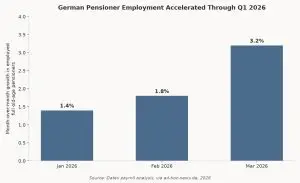
Germany’s new active pension law — the “Aktivrente” took effect this year, allowing pensioners to earn up to €2,000 a month tax-free while continuing to work. The early data is striking. According to payroll analysis from the IT services provider Datev, the number of full old-age pensioners working without social insurance contributions rose 2.1 percent in the first quarter of 2026 compared with the previous period, with March alone posting a 3.2 percent increase, the sharpest monthly gain in years. Datev’s chief economist Timm Bönke pegged the shift at roughly 9,000 additional employed pensioners in the first quarter alone, concentrated heavily among small and medium-sized firms.
Meanwhile, Germany’s broader employment rate for workers aged 55-64 hit 75.2 percent at the end of 2024, a record high, up from a low of 55.3 percent in 2009. That’s is no blip. That’s a structural realignment of what a German career is supposed to look like at 60.
The Script Everyone Assumed Was Fixed
For decades, the German cultural expectation has been unambiguous: you retire around 63-67, you receive a respectable pension, and you step back to make room for younger workers. Staying visibly employed past that point has quietly carried a whiff of something being wrong — either you didn’t save enough, or you don’t know how to let go.
I’ve sat with senior leaders in Düsseldorf boardrooms who will talk about anything — health, marriages, even therapy — before admitting they’re working past 62 by choice, not necessity That discomfort is real, and it’s not irrational — it’s a script that’s been reinforced for two generations. But scripts written for a labor market of 1995 and doesn’t hold up well against a labor market with a demographic cliff and a legislature actively paying people to keep working.
What the “Aktivrente” does, beyond the tax mechanics, is grant social permission. When the state itself is incentivising continued work past pension age, the stigma starts to erode from the top down. My read, having watched several cohorts of senior leaders navigate this exact transition, is that we’re at the early edge of a genuine cultural pivot — and the people who move first, with intention rather than default inertia, will define what “senior professional” means in Germany for the next decade.
Why Most People Actually Want to Keep Working — And Why That’s Not Shameful
Here’s the reframe most transition conversations miss: the assumption is always that people work past retirement age because they “have” to. kids still in university, a mortgage that outlived the mortgage-holder’s original plan, healthcare costs that outpaced projections. Those pressures are real and common. But in my own practice, the more frequent driver isn’t financial. It’s status and purpose.
Rainer didn’t need the money. He needed somewhere his judgment mattered. That’s a completely different problem to solve than a financial shortfall, and it requires a completely different kind of advisory conversation — one that starts with “what does contribution look like for you now” rather than “how do we optimize your pension drawdown.”
This is where the peer-to-peer advisory model earns its keep. A senior leader navigating this isn’t looking for a career coach who’s twenty years their junior explaining LinkedIn optimization. They’re looking for someone who has actually stood in the disorientation Rainer described — and can speak to it with authority rather than sympathy.
What This Means If You’re Considering Your Own Next Chapter
If you’re a senior executive in Germany weighing whether to stay engaged past traditional retirement age, the active pension law removes one obstacle — the financial penalty — but it doesn’t answer the harder question: what specifically do you want your continued engagement to look like? Advisory work, board seats, part-time operating roles, and formal employment all sit under this new incentive differently, and the right structure depends entirely on what you’re actually solving for.
This isn’t retreat dressed up as compromise. It’s reinvention with the tax code finally on your side.