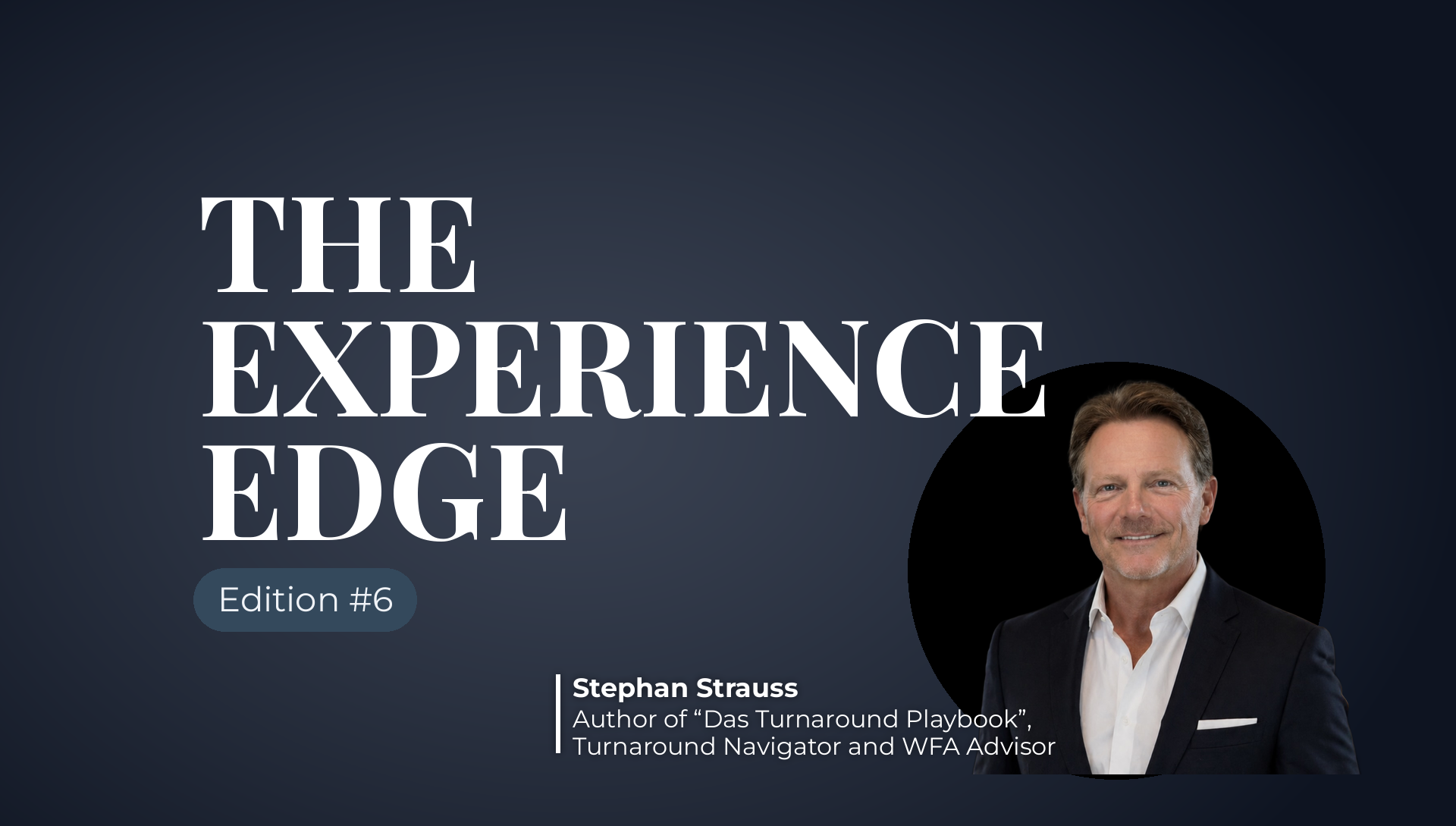
by Stephan Strauss, former CEO of Rexel Germany, turnaround consultant, and author of *The Turnaround Playbook*
There is a special kind of silence that follows a decision you know is the right one.
When I left Rexel Germany in early 2019, I had spent more than 25 years at some of Europe’s largest companies. I started my career at Philips in sales and marketing, first in Germany, then in the Asia-Pacific region and in New York, before moving on to PwC and Barkawi as a supply chain consultant. This was followed by six years at ThyssenKrupp, most recently as Managing Director of ThyssenKrupp Industrieservice, and then seven years at DB Schenker Rail, where, as CEO of the Building Materials, Industrial Goods, and Consumer Goods Division, I was responsible for restructuring and transforming the business model. Large organizations, large budgets, and—as I later had to admit to myself—a great deal of politics. I knew this world very well.
Rexel Germany, formerly Hagemeyer, was my final chapter within the group and, in many ways, the most challenging. For three years, I led the company through a turnaround: approximately 1,700 employees, about 900 million euros in revenue, and five consecutive years of losses. We restructured aggressively and lost about a quarter of our assets: people, branches, infrastructure, and logistics. I worked twelve, fourteen, sometimes sixteen hours a day. And together, we achieved something I’m still proud of today: we transformed an organization that had been managed in a military, top-down manner into one that functioned like a large team.
Then the shareholders decided to take a different strategic direction. Instead of the dual approach of optimization and innovation that we had been pursuing, the focus was to be solely on the core business. I thought long and hard about it, and in the end, it was clear that the new course and I were no longer a good fit. So we parted ways.
Disappointment and relief at the same time
Some people ask me how that moment felt. To be honest, it felt like two conflicting things at the same time.
It was a huge disappointment. We had been working on so many great things, and I felt really bad for the people and teams I was leaving behind. We had grown close. We had built up real momentum there, and many of those people were still in the middle of their own personal growth. Leaving all of that behind was hard.
And at the same time, it was an enormous relief. It felt as if I were stepping off a hamster wheel that had consumed most of my energy for three years. That job had demanded a lot from me, far beyond my regular working hours. The next morning, I simply woke up and was no longer in the role I had been playing up until then. The first word that came to mind was “freedom.”
The tougher questions came later, in the weeks and months that followed. Who am I without this role? How do I fill this void—or can I see it as an opportunity to reinvent myself? None of these questions are answered on the first day.
Five Weeks in New Zealand
I knew I needed a break. So I flew to New Zealand for five weeks, stayed with friends, and used their home as a base to travel around the country. I went hiking, cooked, wrote, and, frankly, cleared my head of a world that had been defined almost exclusively by my role for a very long time.
It was a time of self-reflection and reorientation. I tried to take a broad view of the whole situation: not just what I wanted professionally, but also what I wanted from life beyond any professional goals. I simply needed that time to find my bearings again.
I didn’t come back with a plan. What I did bring back were a few clues—things I knew for sure:
- I wouldn’t go back to the rat race.
- I wanted a more self-determined life.
- I wanted more time for my family, for myself, and for the people closest to me.
Everything beyond those signposts was open-ended. And I am now convinced that this openness is not a weakness of the transition. It is the transition itself.
When the tower starts to wobble
Are you familiar with the game Jenga, where you build a tower out of wooden blocks, pull one block out, and suddenly the whole thing starts to wobble? That’s how the days that followed felt.
Other changes in my life—ones that had nothing to do with my departure from Rexel—made the whole process more intense than I had imagined. And then the pandemic hit, forcing us all to pause and ask ourselves what the “new normal” would look like for society and the economy.
I used this forced break as an extended period of reflection on what I really wanted to dedicate myself to in the future. Two things became clear.
First, I wanted to work on things that make a positive difference for people and the planet, rather than putting profit above everything else. From then on, my criteria were simple: It has to be a triple-bottom-line endeavor; otherwise, I’m not interested. Sustainability in the true sense of the word became central to me, and I began to explore how purpose-driven companies and movements like B Corps actually work.
Second, I had worked for a very long time in very large organizations and was tired of the politics that come with them. I wanted to understand how startups and scale-ups work—company sizes I had never really experienced from the inside—and figure out where someone with my experience could add real value.
Wherever energy goes, attention follows
How do you break into an ecosystem where no one knows you? For me, it turned into a networking game—but not the kind most executives imagine.
I started with the people I already knew in these fields. One conversation led to the next, and then something happened that I’ve experienced many times since: As soon as you focus your energy on something, your attention follows. Out of nowhere, opportunities arose that perfectly matched what I was looking for. A tech platform in Australia that connects sustainability-focused startups with impact investors invited me to join its advisory board, and we recorded a podcast together. Through a friend of a friend, I became a mentor to the CEO of a coding education startup in New York. Things found me, and I found things, and that’s how the ball started rolling.
However, there’s also a harsher truth underlying this. As soon as you step down from a top position, you realize that a large part of your network was tied to the role, not to you as a person. Many of these relationships simply fade away because you’re no longer interesting in the same way.
So I had to start somewhere. One of those places was my Rotary Club. As a Rotarian, I’d rarely had time for the meetings, so I started going again. One of the new members, as it turned out, was the managing director of Scale-up.NRW, the accelerator program of the state of North Rhine-Westphalia. We got to talking about startups—how they work and where I could help. He invited me to join the mentor network, and I’ve been a part of it for five years now.
If you have a broad, cross-industry network: congratulations—this might come easily to you. If you don’t, just start somewhere. And when you approach people, don’t begin with, “I’m looking for something—can you help me?” In my experience, that rarely works. Instead, say, “I’ve seen that you’re working on this. I’m dealing with a similar problem. Would you be interested in exchanging ideas?” Try to offer value rather than asking for help. The help will come naturally as the conversation unfolds. That, more than anything else, is what builds a network worthy of the name.
A Guide to Getting Started
When executives ask me how they should get started—especially those who know they want something different but have no idea what that is—I suggest three questions.
What are your true values? Not the values of your company or your role, but what defines you beyond any position or relationship. Who are you, really?
What are you curious about? What fascinates you—what have you never had time for? It could be sports, technology, philosophy—anything at all.
Where can you experiment? Look for opportunities to try new things—places where you can either add value right away or learn something new. Ideally, both.
Values, curiosity, and experimentation. That’s a compass that’s more than enough to get you started.
The Hardest Part: Letting Go
What do people underestimate the most? That they are still trapped in their last role—often much more than they realize.
The real work, in the sense described by C. G. Jung, lies in learning to let go: the story one tells about oneself, the narrative that was tied to the title. A role that has shaped you over decades becomes a part of who you are, and after years in top positions, it can severely distort your self-perception. But you are no longer in that role. I consider this work on identity—figuring out who you are beyond any title—to be the most important task of the entire transition. Only then can you make sound decisions about where to invest your time, your curiosity, and your experience.
No new hamster wheel
Today, I have what you might call a classic portfolio career. I guide medium-sized companies through turnarounds, mentor founders, coach top executives who are leaving their roles as they transition to the next chapter of their lives, and I write. Do these different parts sometimes conflict, or does it all become too much? Sometimes, yes.
I manage this primarily by listening to my inner voice and asking myself honest questions. Am I in balance? Or am I just building myself a new hamster wheel and filling the void left by my last role with a different kind of busyness?
One simple principle has always helped me: Meaning before profit. I ask myself what truly fulfills me, and then I pay attention to how I spend my time—not just in my professional life, but in my entire life, with friends, family, and everything else that matters. Balance in the big picture is far more important than balance in an isolated set of projects.
Why I Wrote This Book
Throughout my entire career, I’ve had a coach who has guided me as a person, as well as consultants for every specialized topic. What I never found was a mentor in the broader sense: an experienced guide who supports you as a person and, at the same time, can help with strategy, leadership, culture, and organization. I know that many executives are looking for exactly that kind of person. That’s what I offer today, and it’s one of the reasons why I wrote *The Turnaround Playbook* (Vahlen 2026).
I wanted to bring together my perspective on turnarounds in one place, because more and more companies are entering such phases, and there will be many more to come. The book is based on systems theory, and I believe that’s what sets it apart from most approaches to this topic. It explains why people and leadership focus are so important and how to address them in a way that respects how organizations and people actually function.
There was a second, more personal reason. For a long time, I assumed that client acquisition was better handled by others, and I often worked through consulting firms that opened doors for me. At some point, I realized that this was an assumption I’d made about myself rather than a fact, and that I could apply my own turnaround mindset to myself as well. The book became a way for me to reposition myself and to articulate my perspective on turnarounds through my own efforts.
In a way, I didn’t find the mentor I was looking for, so I decided to become one myself. And this book is the map of the terrain through which I want to guide people.
What I would say to Stephan from 2019
If I could sit down with my January 2019 self, my advice would be: Put most of your energy into letting go and figuring out who you really are, and do that first, before you even consider any other opportunities.
The temptation is real. A headhunter comes along and offers you a great job that you’d be perfect for, and you might say yes, only to realize that it’s exactly what you didn’t want. I know this because something similar happened to me, too.
And take an honest look at your burn rate. Many executives maintain a lifestyle that requires a high income: the houses, the boats, the obligations. Use this moment to simplify your life a little. Letting go of material things can make it much easier to let go of the role.
The experience doesn’t go away
People often say that change never stops and that transformation continues. I think I’ve become an example of that myself.
But I’ve come to believe that this is precisely where the meaning lies. We’re not here to live someone else’s life or to be the linchpin of someone else’s organization. Figuring out who we are is the real task. Along the way, we tend to forget that. With a little luck and a few honest moments of reflection, we’ll remember in time.
The experience doesn’t disappear when the title is gone. It finds new and far more interesting ways to make itself felt, along paths much broader than those we’ve traveled so far.
About Stephan Strauss
Since 2019, Stephan has run his own consulting firm and has been guiding medium-sized companies with revenue ranging from 50 million to 1 billion euros through turnarounds—as a sparring partner and mentor for CEOs and, when needed, as an interim co-CEO. From 2022 to 2023, he served as CEO of the startup Trusted Carrier; for the past five years, he has been a mentor to founders at Scale-up NRW; he serves on advisory boards in the sustainability and technology sectors; and he is a co-founder of Republic of Humanity. Today, Stephan is also a WiseForce Advisor and the author of *The Turnaround Playbook*.
*The Experience Edge* is published by WiseForce Advisors. WFA is a pioneer in peer-to-peer consulting for top-level career transitions, drawing on real-world leadership experience. We support executives in shaping their next career chapter—whether they are taking on a new operational role, serving on a board of directors or advisory board, building a portfolio career, or starting their own business.