
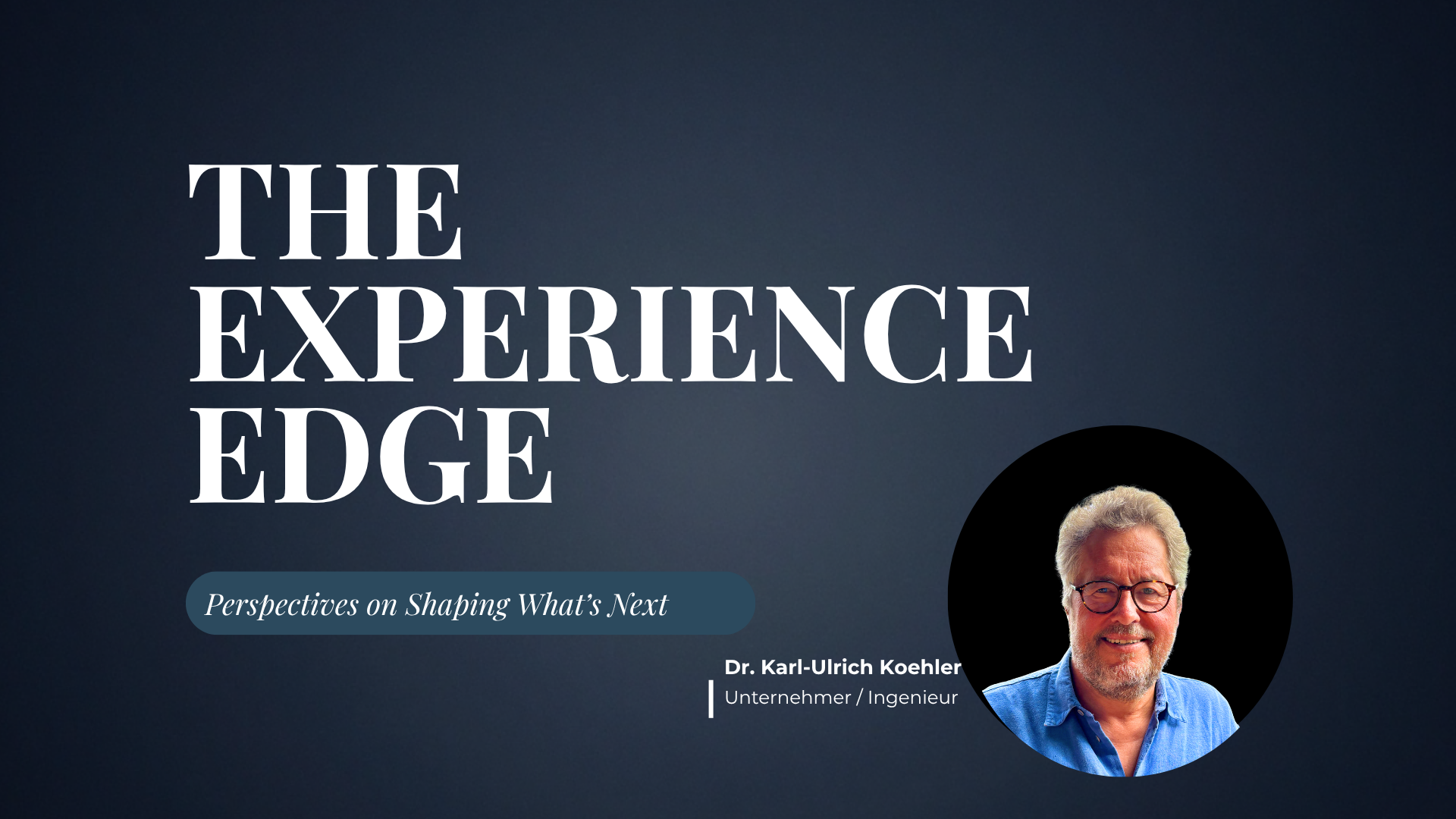
by Dr. Karl-Ulrich Köhler, former CEO of ThyssenKrupp Steel and Tata Steel Europe; currently a member of supervisory and advisory boards in the steel and metals industry
I had worked for ThyssenKrupp and its predecessor companies for 29 years when I was forced to leave the company in 2009. I was held responsible for cost overruns and delays in our major investment project in Brazil. I was in my early 50s, had four children between the ages of 14 and 24, and the foundation on which I had built my professional life was gone from one day to the next.
What I learned in that moment has carried me through three more chapters of my career ever since.
It’s the people, not the organization
When you identify with a company as if it were your own family, you’re left feeling pretty lost as soon as that one pillar of support crumbles. The first realization came quickly: Companies don’t treat you well or badly. But in the end, a company is always an organization of people, and those people have a motive—one that’s supportive or one that’s distracting. Sometimes the motive is simple: better you than me.
I’ve made that a rule for myself. There’s no point in quarreling with an anonymous organization. At most, it’s worth taking issue with the judgments and behavior of specific individuals in positions of responsibility. That was a learning process—in my early 50s and with four children, some of whom were suddenly confronted at school with sensationalist newspaper articles and gossip about their father.
A Look in the Mirror
The second thing that helped me get back on my feet was a simple question: Had I done everything in my power?
Whether the outcome was good or bad is one thing. What matters is whether you gave it your all, listened to advice, and prepared as well as you possibly could. Anyone who can answer that question with a clear conscience has the resilience to get back on their feet, even if something important went wrong. After I left, I was subjected to several audits. They found nothing. Whenever in doubt, I always acted the way you act when you know you’re under scrutiny. You’re more careful with a company’s money than with your own.
Comrade Chance
Then the question arose: What do I do now? The answer came about by chance. Two friends’ company was in a difficult financial situation. The question was whether I could help them, for example, with a loan. It turned into something else: I got involved and became a partner.
Years later, when the founder wanted to sell after 40 years, I said: “This has always been a family business, and it should remain so.” I made sure that part of the business passed to my family—to my children, who are all well-educated and hold management positions themselves. They don’t have the time to run a company, but they can oversee and guide it. To that end, we established an advisory board, which I now chair. The company is called Almamet, an international manufacturer and recycler of magnesium and metallurgical products with locations in Europe, China, India, Turkey, South Africa, and the U.S., among other places. There’s no mention of this on my LinkedIn profile. I’ll get to that later.
The Saarland Group’s Turnaround
The next chapter didn’t come from a plan either. In 2019, I was asked if I could take over the leadership of the struggling steel group in the Saarland—two companies that were both deep in the red. The coronavirus pandemic was just breaking out. My wife simply said, “You’ve got that happy twinkle in your eyes again.” I let myself be talked into it.
By 2023, we had turned the group around from a significantly negative EBITDA to profitability. The market has developed favorably—that’s part of the story. But we also seized opportunities and restructured the company. Steel remains a challenging business; no turnaround can change that.
What preoccupied me the most was the difference between managing a large corporation and leading a family-run small-to-medium-sized business. In the corporate world, everything is cascaded down; every decision passes through various levels. In an SME, things are more direct, but sometimes also less structured. When I had to write down a goal in an annual plan for the first time in my professional life—with a specific number attached to it that I was held accountable for—it felt strange. Later, I realized how much that drove me, because I measured myself against what was written there. Since then, I’ve brought exactly those kinds of structures with me in both directions: more systematic approaches in our company where they were lacking, and more directness where large corporations have lost that quality.
A workload that feels like retirement
I currently work between 30 and 40 hours a week, spread over seven days, including travel time. Back in my corporate days, as I recall, it was definitely 80 hours—though I’m not entirely sure about that number myself, because I never counted the many nights I spent on airplanes.
To me, my current workload feels like retirement, even though I’m still traveling a lot—to symposia, client meetings, and sales meetings. I no longer manage day-to-day operations. I can work behind the scenes, analyzing, asking questions, guiding people, and taking a closer look at specific issues. I’m constantly learning in the process, especially when it comes to a material like magnesium, which behaves completely differently in metallurgy, as a catalyst in chemistry, and in pyrotechnics—and is correspondingly challenging to handle.
In addition, I serve on the board of trustees of the Montanstiftung Saar, which helps make the region less dependent on steel, among other things by supporting startups and venture investments. And I have a stake in a geothermal energy company that has a good reputation in Germany. It’s the same observation time and again: there are people with ideas, and there is capital looking for a place to be invested. Bringing the two together—that’s what appeals to me.
Why I Don’t Post This on LinkedIn
My mother always said, “Decent people don’t make the news.” I’ve adapted that to today’s world. That’s why my profile says “Retired” and not much else. I’d rather talk about what else I do in person than post it online.
Part of that is also coaching. I mentor people who ask me to, without me having to make any effort to do so. They come to me with a specific question, wanting to discuss things or hear some advice. What’s discussed in these conversations stays between us. I enjoy this, and I think it’s connected to what drives me overall: curiosity, a willingness to learn—at my core, I’m an engineer with a dash of entrepreneur in me.
What I Would Contribute to the Debate on the Retirement Age
There are the well-known examples of the roofer who, after a hard life of work, is tired and physically limited. That’s a topic in itself, and it’s entirely valid. But anyone who has the chance to grow into a different role should take advantage of it. How many older people volunteer?
For me, work and life were never two separate things. My work was my life, and my life was my work. Aside from family and my career, there was little else in my life, and that was enough. Why should I stop doing what I’ve learned over decades as long as there’s a need for it? This doesn’t just apply to my own children. I’d rather make use of what I’ve worked so hard to achieve and pass it on.
I think this can also be applied to leadership in general. To me, political leadership means convincing people of what is right, even if hardly anyone wants to hear it at first, rather than looking at the polls and delivering what they say. Understanding the future as part of one’s own responsibility is, above all, a matter of willingness.
I’m 70 today. And I hope I can keep doing this for a long time to come.
Dr. Karl-Ulrich Köhler served as Chairman of the Executive Board of ThyssenKrupp Stahl AG from 2001 to 2009 and was responsible for the steel division before leaving the company in connection with the Brazilian steel mill project CSA. From 2010 to 2016, he served as CEO of Tata Steel Europe and as a board member of Tata Steel Limited in India; he then served as Chairman of the Management Board of Rittal, a company of the Friedhelm Loh Group in Hesse, until 2020. From 2021 to 2023, as Chairman of the Executive Board, he led SHS – Stahl-Holding-Saar, Saarstahl AG, and AG der Dillinger Hüttenwerke through the COVID-19 crisis and a financial restructuring. Today, he is a member of the Board of Trustees of the Montanstiftung Saar and Chairman of the Advisory Board of the Almamet Group.