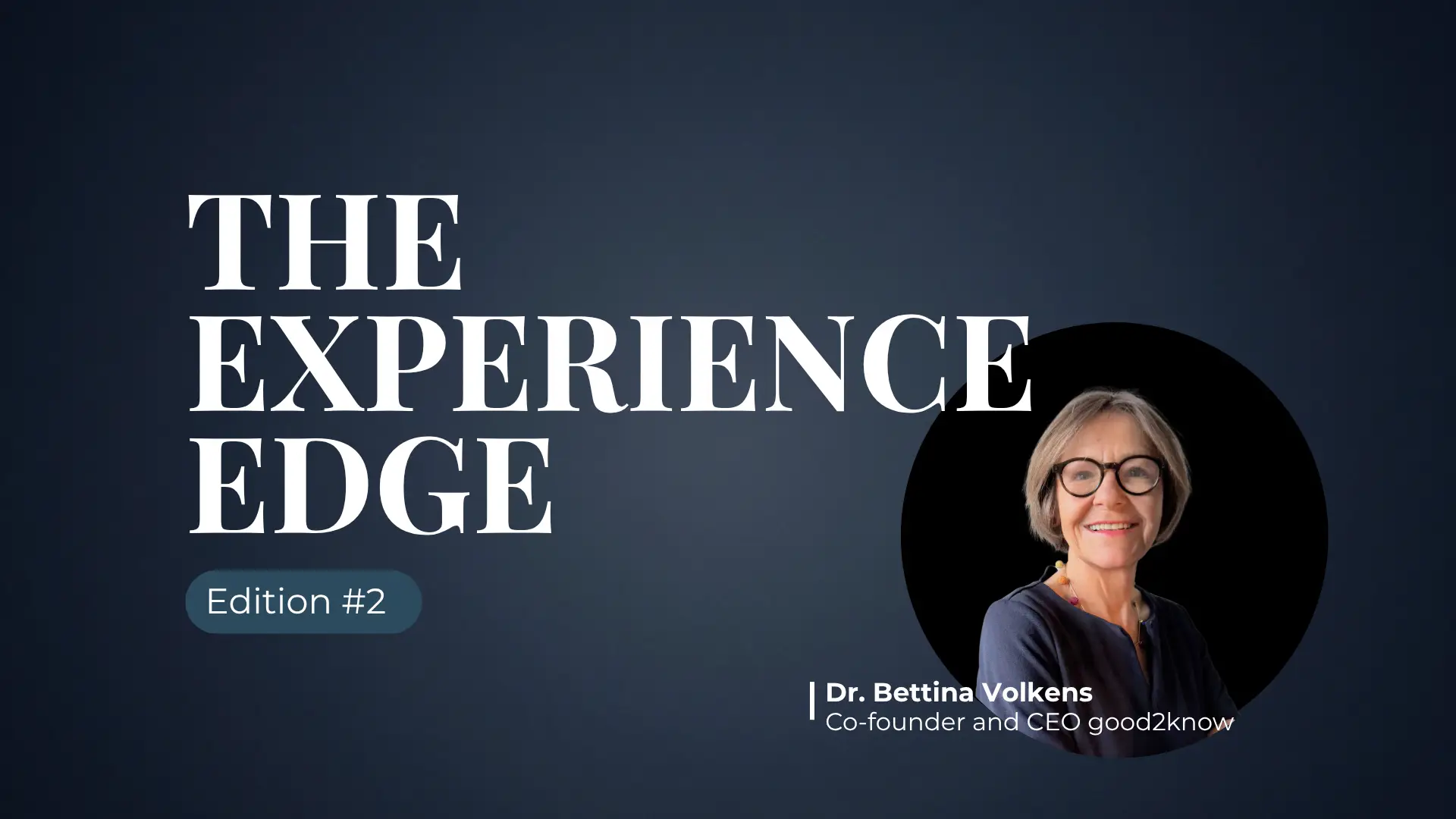
by Bettina Volkens, Co-Founder great2know, former Chief People Officer Deutsche Lufthansa AG
When Covid started, I had just left Lufthansa. We did puzzles. The whole family, together, until we’d worked through every puzzle and every game more than once. That might sound unspectacular for someone who had spent six and a half years on the executive board. But I experienced that time as something genuinely valuable. For the first time in years, I was simply present – for my family, for things you don’t have time for as a board member. I took on the chairmanship of a non-profit, helped at my children’s school, did volunteer work.
And I thought. What am I actually going to do with my time now?
That’s a question you rarely get to ask yourself seriously in a role like that. In your professional role, you always know what comes next. Afterward, suddenly you don’t. I experienced that as an opportunity to look honestly at myself: What actually gives me energy? What do I enjoy? The question wasn’t what I was good at – I knew that. It was: what do I actually want?
Trying things out without committing
What followed was a period of experimentation. Without much of a plan behind it.
I was asked whether I wanted to join supervisory boards. I said yes. I took on advisory mandates. I quickly realized that just being an advisor isn’t really what I want to be. Or at least not the only thing.
I never went to headhunters. That was clear to me from the start. I was approached, of course – that always happens when you’ve been in a position like that. But I didn’t want to simply step into the next treadmill, and my husband had also been very direct about it: don’t do that again. When you come from a board position, jumping into a comparable DAX role isn’t so straightforward – I don’t really know anyone at that age where it’s worked out. So it was clear to me that this wasn’t an option.
What I would recommend to others in a similar situation: give yourself time to try things out without committing too quickly. There are people who immediately run to a headhunter and signal that they absolutely need to get back in. That can burn you – people can tell when someone is desperate. Of course: if you’re financially dependent on it, you have to search, and maybe after the third offer you can’t say no anymore. But if you’re not – you don’t need to be nervous. That’s a privilege worth using.
Being on the board is a role
Something that helped me, and that I’d like to pass on early: being on the board is a role. The person behind it is a separate matter.
That sounds obvious. I don’t think it is for many people. Suddenly you no longer have a driver, no office. You stop getting invited to events, because you were on the guest list because of the role. That happens very quickly, and it can be hard when you’ve tied your identity too closely to the function.
I always kept that distinction – between role and person – in mind. That’s why the transition wasn’t difficult for me.
I was asked to leave – I say that openly. There was no shared strategy around a major labor conflict, and when that’s missing, a separation is the logical conclusion. We didn’t part on bad terms; that mattered to me and I worked at it. A phrase my then-CEO once said to me has stayed with me ever since: “What you can’t change, you can’t change.” That sounds simple, but there’s a great deal in it – not spending your energy looking backward, but asking: what can I shape now?
I think it ultimately comes down to personality. Those who always knew that the role was a role and the person a separate thing – they arrive at what’s next sooner. Those who confused the two need more time. And that’s perfectly fine. That’s time worth taking.
The accidental founding
I didn’t plan my startup. I met with a former colleague from Lufthansa – she had been responsible for onboarding and knowledge transfer there. I wanted to learn about those topics. She told me about something she’d been envisioning for a while: a scalable solution for a process we used to handle analog at Lufthansa. When executives changed, we organized structured conversations with their predecessors – so the knowledge would stay and not leave with the person. There had been technology platforms that offered something similar, but they were too expensive. And then I said: what an idea! Entire postwar generations are retiring, all that knowledge is walking out the door – let’s start a company.
Without really knowing what that meant. I can say that now. There have been hard times, and there still are. But I’d do it the same way again.
At Lufthansa, I always tackled things a little earlier than others – introduced New Work concepts in 2014, before anyone was talking about them; abolished individual bonuses, only the second company in Germany to do so. That intuition – that something will matter before everyone else sees it – I had that then too. I didn’t want to found a startup. That was never in my mind. I wanted to move a topic forward – and the startup turned out to be the right form for that.
Why this topic is urgent right now
In most companies, a large part of knowledge is undocumented – in some industries, 80, sometimes even 90 percent. The knowledge that actually matters sits in people’s heads: how decisions are really made, which processes exist on paper but are lived completely differently in practice, what went wrong in the last major project. When these people leave, the knowledge goes with them.
That was already a problem before. Boards suppressed it for decades. And it led to cost overruns, long onboarding times, mistakes that kept repeating.
Now, with the rise of AI agents, it’s becoming truly acute. Many companies upload their documented processes into AI systems – and are surprised when it doesn’t work as hoped. The reason is that the processes as written down are often not the processes as they’re actually lived. Garbage in, garbage out. And AI amplifies that.
At great2know, we’re building a corporate memory. Interview-based, AI-supported – an AI moderator structures the conversations, categorizes the knowledge, and brings it into the system. Documents aren’t unimportant, but the real knowledge usually lives elsewhere. 28 companies are already working with us. The market is just beginning to recognize the problem.
What I’d pass on
Take your time. Really. Taking your time sounds passive – but it isn’t, not really. It’s a deliberate decision to resist the pressure to immediately land somewhere again.
Try things out without committing. What gives you energy? That’s the more important question than: what am I good at?
Remind yourself that you played a role – and that the person behind it continues to exist when the role is gone.
And if you were asked to leave: give yourself the space to process that. It’s a different starting point than leaving on your own terms. Both paths eventually lead to the same terrain – but the routes are different, and that difference deserves to be taken seriously.
What you can’t change, you can’t change. That’s a very good starting point for almost everything.
Bettina Volkens served for six years as a member of the Management Board of Deutsche Lufthansa AG, responsible for Human Resources and Legal – including some of the most intense collective bargaining and transformation periods in the company’s history. Prior to that, she held leadership positions at Deutsche Bahn AG. Today she is Co-Founder and CEO of great2know, a platform for AI-powered knowledge transfer, and serves on several supervisory boards.