
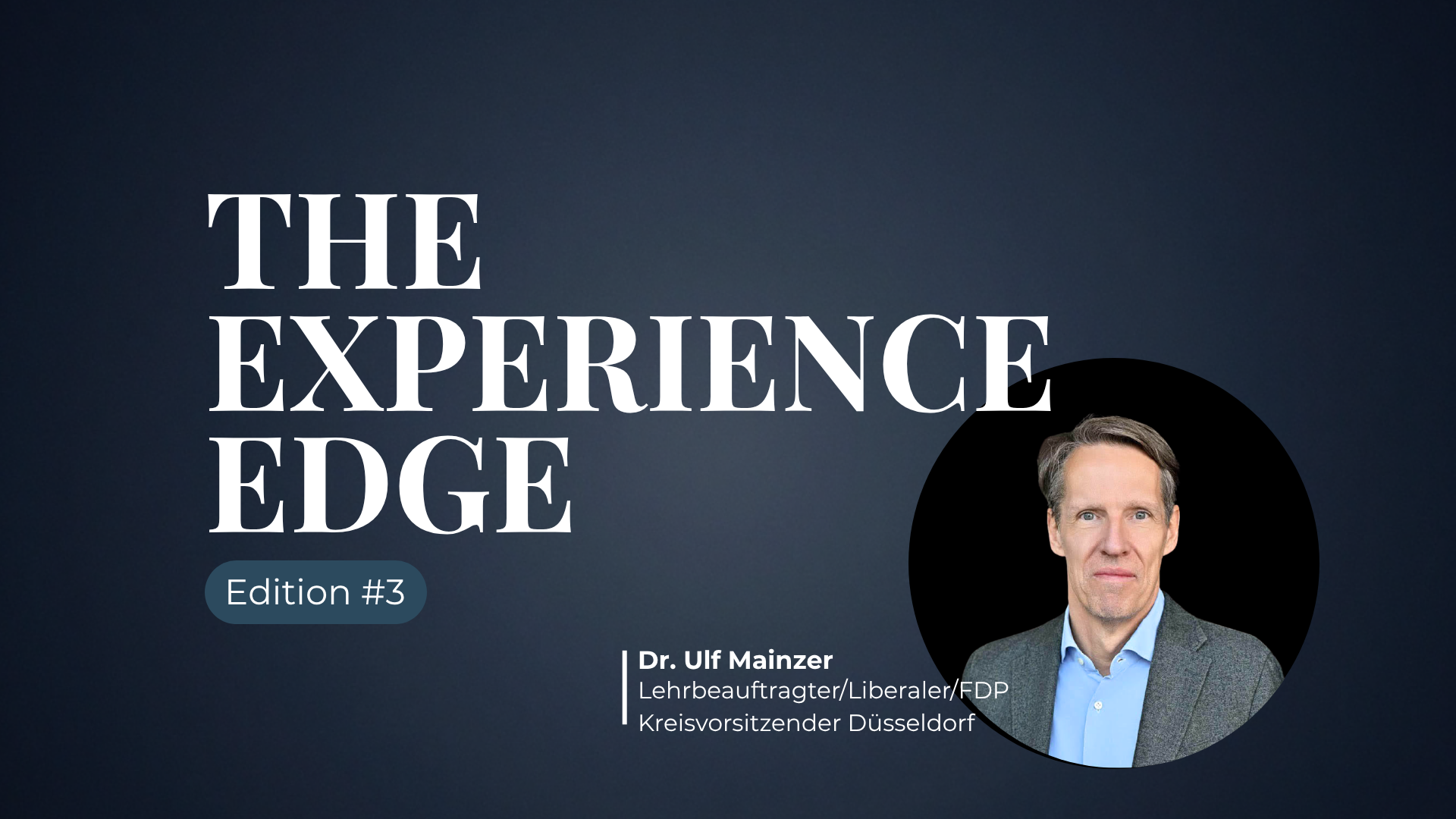
by Dr. Ulf Mainzer, Adjunct Professor/Liberal/FDP District Chair in Düsseldorf
At age 60, my time on the ERGO Executive Board came to an end after nearly 18 years. That’s what the company’s rules stipulate. I’ve always thought that was the right approach—generational change should happen sooner rather than later. I enjoyed the work, loved collaborating with people, and was fortunate to experience a successful and fulfilling time. That often meant working 80 hours a week—sometimes even more.
Today, I like to look back on those years. And I’m just as glad that they’re over. Both are true.
I never would have believed myself back then that I would one day spend nearly two decades in the international insurance industry. I don’t come from the financial sector, nor was that ever my plan. As a lawyer with a background in business administration, I initially worked in various companies and industries. Thirty years ago, I would have lost any bet if someone had claimed that I would one day retire as a member of the executive board of an insurance group.
Things turned out differently. And that was for the best.
Because I had been with the company for so long, my retirement benefits began at age 60. So my departure came as neither a surprise nor an inconvenience. On the contrary: I was looking forward to starting something completely new once again.
The Plan: Balance Instead of a Career
I had two possible paths ahead of me.
Many former executives choose one path: seats on supervisory boards, consulting roles, perhaps even another executive position. All of that would have been possible. I wanted the opposite. To get out of the corporate world—not just a little, but as completely as possible.
Instead, I felt like starting a new life. I already knew that I would be taking on a teaching position at Heinrich Heine University, where I’ve been teaching for many years. I’ve always enjoyed teaching. To this day, I consider it a great privilege to share my experiences and work with students. Including preparation, this now takes up ten to twelve hours a week.
At the same time, I’m studying philosophy myself. For me, it’s the fulfillment of a long-held dream.
Share what you know. Learn what you still need to know.
And then there was sports.
For many years, triathlons, marathons, and bike races—such as the Ötztaler Bike Marathon—were a big part of my life. Training ten to fifteen hours a week was the norm. I always had a specific goal in mind.
This combination led to my personal model for this new phase of life: a balance between mind and body. And time for the family. Our two daughters—one of whom is still in school—should see their father more often than they had in previous years.
The plan was surprisingly simple. And it worked. Well, almost.
The Surprising Part
Because then something came up that wasn’t part of any plan: politics.
I had already been a member of the FDP a few years ago. I resigned during the “traffic light” coalition. Immediately after the party lost its seats in the Bundestag, I rejoined. My thinking was simple: That couldn’t have been the end of political liberalism.
Shortly afterward, the phone rang. The FDP was working on a new policy platform. From my previous work with professional associations, I knew a few people in Berlin who were active at the intersection of politics and business. The question was brief: “Would you like to help out? We could really use your experience in business, social, and labor law.” I agreed.
Looking back, that was probably the moment when it all began. I thought to myself: If you’re going to help draft a party platform, you should first know what issues matter to the people in your own party. So I wrote to the local chapters in Düsseldorf. They invited me. I took a little tour of the city and visited one chapter after another. And at some point, it suddenly wasn’t about the platform anymore.
Several members asked me if I could imagine taking on a leadership role in the district chapter and helping to revitalize the Düsseldorf FDP.
The whole person is at issue
The conversations eventually led to a specific question: whether I would be willing to run for district chair.
The Düsseldorf FDP was going through a difficult phase at the time. After years of leadership that was perceived as tactical, not open enough, and not inclusive enough, many members were hoping for a fresh start. I hesitated for a long time; my desire for the spotlight and attention is fairly limited.
In the end, I ran for office. And I won.
An internal party campaign like this is an interesting experience. Unlike in professional life, suddenly it’s not just your work that’s under discussion, but your entire person. Everyone forms an opinion. Everyone is free to express it. You’re praised, criticized, misunderstood, and sometimes assessed with surprising accuracy. That’s all part of it.
In a company, you usually operate in a familiar environment. You know the rules, the language, and the expectations. Politics works differently. It’s more public, more immediate, and far less predictable. And it’s more democratic. That may sound obvious, but it makes a surprising difference.
Democratic processes are rarely the most efficient. Fortunately. Their purpose is not to make decisions as quickly as possible, but to take as many perspectives into account as possible. People coming from the business world have to get used to this at first. I, for one, certainly did.
A business that doesn’t operate efficiently
My wife asks me the same question regularly: “How much more time do you actually plan to devote to politics?” The honest answer is: more than I originally planned.
Above all, communication takes time. The phone rarely stops ringing. Düsseldorf is one of the FDP’s larger district associations, and through the state executive committee, you quickly find yourself dealing with issues that extend far beyond the city. Suddenly, you’re no longer juggling three projects at once, but thirty.
My first instinct was familiar: assign tasks, define responsibilities, set deadlines. Something along the lines of: “You do this, I’ll take care of that, and by next Wednesday, everything will be done.” You try this exactly twice. After that, you realize that politics works differently.
Not worse. Just different.
Most people volunteer. They have jobs, families, vacations, and sometimes simply matters that are more important than the agenda of a board meeting. It’s easy to forget that when you’ve spent decades working in a world where deadlines are part of your employment contract.
So you learn to think differently.
Set priorities. Don’t start twenty projects at once; instead, see two or three through to the end. Celebrate your progress instead of getting frustrated by everything that hasn’t been done yet.
And above all: appreciate the efforts of those who devote their free time to this cause. Volunteer work doesn’t thrive on instructions; it thrives on motivation. Incidentally, this insight isn’t entirely without value for managers either.
Three Is One Too Many
I’m still trying to find a balance in my new life.
Teaching, studying, and sports—those are actually three major commitments. The only problem is: I really enjoy all three. That’s why I’ve cut back on sports a bit for now. Not drastically, but enough so that it’s a form of relaxation again rather than just another item on my schedule. I don’t know if that will be enough in the long run. At some point, something will probably have to give or be significantly scaled back.
Why I Put Myself Through This
For me, politics is more than just a volunteer position. It offers something that has become rare in many areas of life: the opportunity to actually make a difference. And it’s a constant learning experience.
I’ve spent my professional life in organizations that were able to make decisions relatively quickly. Politics works differently. It’s slower and more contradictory—but that’s also what makes it so fascinating. Democracy thrives on the clash of different interests and the search for compromise. That takes time. And sometimes, it’s a bit of a nerve-wracker.
I want to make a difference. That was true throughout my professional career, and it’s no different today. At the same time, I enjoy being a beginner again. I learn something new every day—about political processes, about people, and, not least, about myself. Standing still has never been my strong suit.
By electing me as district chair, the members have placed their trust in me. I see this trust as a responsibility. Anyone who is elected owes the people who voted for them their full commitment. It certainly sounds a bit old-fashioned, but I suppose I’m quite Prussian in that regard.
What I would advise others to do
If anyone reads my story and thinks, “This might be something for me, too,” then I have two tips.
The first one is quite simple: Just do it. Not someday. Now.
Most people wait to be asked. I don’t think that’s necessary. If you want to get involved, you shouldn’t just put yourself out there—you should offer to help. The difference is greater than you might think at first. Just pitch in. Listen. Lend a hand. Without expecting to be given a role or a title right away. The rest often falls into place surprisingly quickly.
However, I do consider one condition to be important. Politics should never become the sole focus of one’s life. Anyone who defines their recognition, friendships, or even their economic livelihood exclusively through a political party, a political office, or a public position is placing themselves in a position of dependence that I would not advise anyone to enter. Soon, every defeat, every pointed statement, and every willingness to engage in conflict becomes a matter of survival.
That is why I consider a certain degree of independence to be a great advantage. It fosters composure and makes it easier to voice an uncomfortable opinion from time to time. Politics needs people who have something to lose—not people who would lose everything without politics.
Of course, you also hear comments like, “He skipped twenty years of local party work.” That’s actually true. Politics is also a craft. It needs people who put up posters, organize meetings, take minutes, and tighten the famous screws that keep the machine running. Without them, nothing works at all. At the same time, every organization thrives on the fact that people from outside also join. With different experiences. With different questions. With an unbiased perspective.
The two go hand in hand.
My second piece of advice is: Take good care of yourself.
Politics has an astonishing pull. There’s always one more appointment, one more phone call, one more meeting, one more message that you really ought to respond to right away. It quickly turns into a full-time job. I’m grateful that I already had a fulfilling life before this: my family, college, my studies, and sports. These anchors still help me today. They remind me that politics is important—but it’s not everything.
Politics would effortlessly take up all the available space. One can—but does not have to—give it that space.
What I didn’t expect
The most interesting developments in life are rarely the ones you plan down to the last detail. They happen because you say “yes” once—to a phone call, to an invitation, or to a task where you don’t even know at first where it will lead. For many years, I worked in a world where planning, achieving goals, and reliability were among the most important virtues.
Today I know that not everything life has in store can be planned.
Thank goodness.
I like to look back on my time in the corporate world. It shaped me, opened many doors for me, and prepared me for a great deal. Above all, however, it gave me the freedom to start something completely new once that chapter had come to an end.
Perhaps that is the real message of this story. Retirement is not a place. It is an opportunity. An opportunity to become a student once again. To take on responsibility once again. To start over once again.
In any case, I don’t plan on stopping anytime soon.
Dr. Ulf Mainzer served on the ERGO Executive Board for nearly two decades and retired as scheduled at age 60. For many years, he served as vice chairman of his industry’s employers’ association and helped negotiate major collective bargaining agreements in the financial services sector. Today, he teaches as a lecturer at Heinrich Heine University in Düsseldorf, is studying philosophy himself, and is active as chairman of the Düsseldorf FDP as well as on the state executive committee. In his free time, he participates in endurance sports.