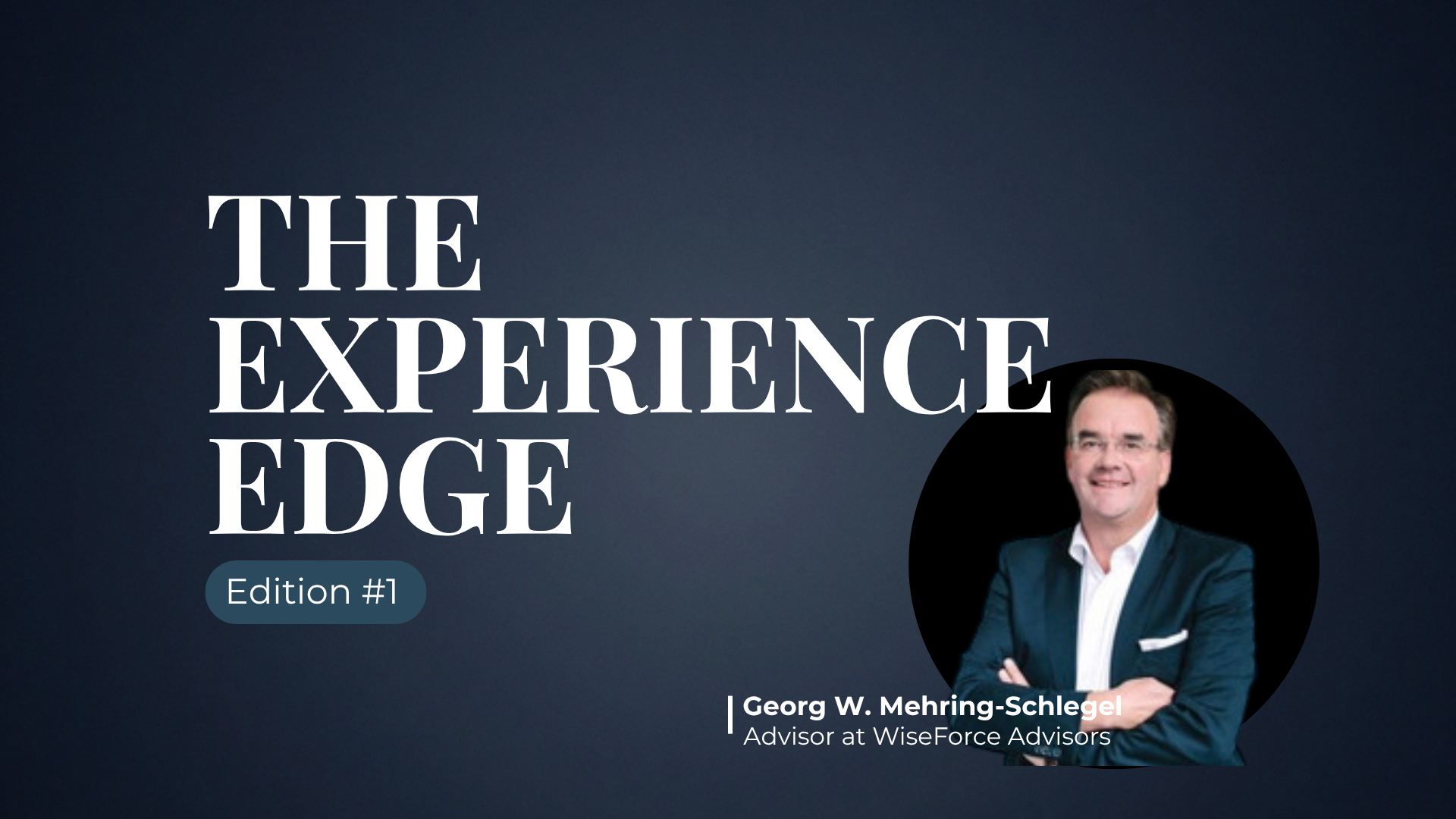
By Georg Mehring-Schlegel, former CFO of MediaMarktSaturn
Two minutes. That’s how long it takes for a corporate career to end.
One moment you’re a CFO with three assistants, two company cars, and a calendar that runs three months ahead. The next, you’re clearing out your desk, saying goodbye to people you know you’ll almost certainly never see again – because from this moment on, in the eyes of the organisation, you belong to the old order. You walk out through the lobby, and you think: right. That’s that, then.
I was 54 years old when it happened to me. After more than 30 years in finance – a traineeship at a London trading floor that felt like a scene from Wolf of Wall Street, a stint as personal assistant to a group CEO, leading the acquisition of a €3.5 billion stake in Metro, and eventually serving as CFO of MediaMarkt Saturn – I was shown the door. Neatly, professionally, and with exactly the warmth you’d expect from a large corporation.
Which is to say: none.
I don’t say that bitterly. I had spent enough of my own career on the other side of that equation to know how it works. Companies don’t love you. They use you well, or they use you badly, but they don’t love you. The day you stop being useful to the strategy, the strategy moves on. I had spent enough of my career on the other side of that equation to know exactly how it works.
What surprised me wasn’t the ending. It was what came after.
The Mallorca Moment
The next morning – not a week later, not a month later, the very next morning – I got on a plane to Mallorca. I have a house there, and I needed to think.
Not to escape. Not to grieve. To actually sit down and work out what I wanted the next chapter to look like. I gave myself three or four days. By the time I flew home, I had made the most important decision of that period: I was not going to pursue another CFO role.
That wasn’t obvious, and it wasn’t easy to say. I was still young enough, and my CV was strong enough, that the headhunters would have come calling. They always do. But what had also become obvious, after 30 years of living in hotels and commuting between Bochum and wherever the job happened to be, was that I was done with that particular version of my life. My family had been in Bochum throughout. I had been everywhere else.
So the question on that terrace in Mallorca wasn’t: “How do I get the next big job?” It was: “What does a genuinely good next chapter actually look like?”
The answer I arrived at was deliberately broad: some advising, some board work, perhaps some investing. What I didn’t know – couldn’t know – was how any of it would actually unfold. And that ambiguity, I have since learned, simply has to be walked into. There is no solving it in advance.
The Year I Don’t Talk About Much
What I haven’t mentioned yet is the year that ran parallel to all of this.
When a full board is replaced – which is what happened at MediaMarkt Saturn – there is a contractual process. There are also, sometimes, less pleasant processes. In our case, the incoming shareholders decided, shortly after paying the outgoing CEO a substantial severance, that it might be prudent to run an expense audit on the remaining board members. And then, when that produced nothing, a broader audit into whether we had communicated financial results accurately to the parent company.
This went on for almost a year.
I will tell you honestly: I knew I had nothing to hide. But financial communication is not always binary, and anyone who has ever operated in that environment knows that there are grey areas in forward guidance, in conditional statements, in what you say when you believe the business is recoverable and the market later proves you wrong. The inquiry, even when you know it will ultimately come to nothing, sits on you. You wake up at 3am and think about it.
It was resolved – in our favour, as it turned out – and it did improve my negotiating position. But I wouldn’t wish that year on anyone.
The reason I tell this is not to relitigate old battles. It’s because no one talks about this part. The abrupt exit is acknowledged, the new chapter eventually celebrated. The in-between – the limbo, the legal shadow, the slow erosion of certainty – is the part people tend to skip over. It’s also the part that tests your character more than any job ever did.
The Trap They Don’t Warn You About
Here is something I see consistently, in myself and in people I know who have gone through similar transitions: you invest too quickly.
Not just financially, though that too. I’m talking about the broader pressure to look busy, to look relevant, to have a title that makes sense at dinner parties. You’ve come from a world of structure and status, and suddenly you have neither. There’s this quiet, relentless internal pressure – not from others, usually, but from yourself – to prove that you’re still someone.
And so you say yes to things you should have sat with longer. You put “Investor” on your LinkedIn profile before you’ve actually invested in anything sensible. You join a board that sounds impressive but offers no real leverage. You walk into a startup pitch, hear a compelling story told by someone who can really sell, and write a cheque because you want to be part of something new and dynamic – and also because you don’t want to admit, at the next event you attend, that you’ve been sitting at home.
From what I’ve seen among peers who made this transition in their mid-to-late fifties: more than half the investments went wrong. Either completely lost, or sitting as a permanent entry in the portfolio that no one quite knows what to do with.
My advice is simple, and I give it every time someone asks: choose your investments wisely, and choose them slowly. Not because you’re old and should be cautious. But because you have the luxury – finally – of not being rushed. Use it.
The Anchor
What actually worked, in my case, was something I also couldn’t have fully planned for: an early anchor.
A week after Mallorca, I had a call from the Paris office of Bain & Company. They asked whether I’d be interested in serving as a Senior Advisor. I thought about it seriously and said yes – and that decision changed the shape of everything that followed.
Not because the work itself was always intellectually thrilling. The first dimension of being a senior advisor at a consulting firm is, if I’m being completely honest, being a kind of respectable grey wolf in the room – the person who sits in on the pitch to a major corporation and provides the credibility that a roomful of twenty-eight-year-olds, however talented, can’t generate alone. I did that two or three times. It’s fine. It’s also mildly boring.
What Bain gave me was something more valuable: a brand. An anchor. A way to introduce myself in transition that wasn’t “former CFO of X” and wasn’t “Investor” and wasn’t “Founder of Georg Mehring-Schlegel GmbH.” It was affiliation with an institution people take seriously. And from that affiliation, real work followed – including a multi-year involvement in major industrial projects in Saudi Arabia that I couldn’t have anticipated and wouldn’t have found any other way.
The lesson I draw from this is not “work for Bain.” The lesson is: find your anchor, and take your time finding it. Something that stands up on its own. Something that gives the next chapter a spine. Because the temptation to grab the first thing that offers itself – the startup, the advisory role with the nice logo but unclear mandate – is enormous, and the anchor you choose in the first year shapes everything that follows.
You Have to Actually Start Again
The hardest thing, in my experience, is not the loss of income or status. It’s the loss of the shortcut.
In a large organisation, you have earned your position. When you walk into a room, there is a shared understanding of what you represent. You don’t have to build it from scratch. You walk in as the CFO, and the conversation starts from there.
In the next chapter, that’s gone. I remember arriving in Riyadh to work with a team on a project and being introduced – quite casually – as the new senior advisor. No one in that room cared what I had done before. I was, again, starting from zero. And I was in my mid-fifties.
That experience, if you let it, is genuinely humbling in the right way. You remember what it felt like to have nothing yet. You realise that the things you thought you had – the network, the reputation, the knowing-the-right-people – are far more perishable than you assumed.
Your network starts to decay the day you leave. Not overnight. But gradually, reliably, it does. The CEO who took your call last year is gone, replaced by someone who doesn’t know you exist. The people who were enthusiastic about having lunch now have other priorities. That’s simply how organisations work – and if you have built your identity entirely around one institution or one role, you will feel it more sharply than you expect.
The thing that helps, if I had to name one, is having maintained relationships for their own sake – not for utility, but for actual human connection. The friends I’ve had since long before the career, the people I’ve met over decades who I stayed in touch with not because they were useful but because they were interesting: those networks are alive. The corporate ones are not, or not in the same way.
In Germany – and I suspect elsewhere in Europe – there’s still something slightly embarrassing about reinvention. In the United States, saying “I’m reinventing myself” at a party is almost a badge of honour. Here, it tends to be the thing you explain after the fact, once it’s worked. Once you can say: I stepped away from the corporate world, and now I do this, and it’s actually quite good. The story is only comfortable once it has a happy ending.
But you have to live through the part where it doesn’t yet.
What I Would Tell Someone at the Beginning
Be patient. Not indefinitely – the window doesn’t stay open forever, and the network won’t wait for you – but genuinely, deliberately patient. Resist the pressure to look busy before you’ve decided what busy should mean.
Find an anchor, and make sure it’s real.
Be honest about what you are and aren’t capable of. I was a finance person. When people brought me opportunities in technology, I had the good sense to say no. Partly because I knew nothing about it. Partly because the best version of what’s next has to be built on what you actually know, not what you wish you knew.
And – this one took me a while – don’t be afraid of the fact that you’re starting again. Not despite everything you’ve built over 30 years, but because of it. The experience doesn’t disappear when the title does. It’s the whole point.
Subscribe to The Experience Edge
The Experience Edge is a monthly LinkedIn newsletter exploring how experience shapes what’s next — through stories, perspectives and ideas from senior leaders, advisors and executives navigating their next chapter.